April 12, 2010

tumbrel or tumbril

Tumbrel
world-travel-photos.com/routard-photo
——————————————————————
MEANING

tumbrel or tumbril  /TUM'bril/ n.  ➤ French two-wheeled dumpcart or wagon designed to be drawn by a single draft animal.
➤ Originally used to carry agricultural supplies, it was most often associated with the cartage of animal manure. 
Synonyms: farmer's cart, farm tipcart, dung cart.
➤ It was also used, however, by artillery units to carry tools and ammunition, and during the French Revolution  it gained wide celebrity as the vehicle used to bear prisoners to the guillotine.   
Synonym: instrument of punishment 
—"tumbrel." Encyclopædia Britannica. 2010. Encyclopædia Britannica Online. 11 Apr. 2010.

"Sidney Carton and the little seamstress rumble off 
to their deaths in a tumbrel escorted by Jacobins."
Dickens, Charles. A Tale of Two Cities. 
Illustration by A. A. Dixon. London: Collins, 1905. 
(From the personal collection of George Gorniak,
 Editor of The Dickens Magazine.)
——————————————————————
ORIGIN


[Middle English tumberell, from Old French tomberel, from tomber, to let fall, perhaps of Germanic origin.] —AHD4


——————————————————————
Tumbrel IN USE
In coats and ties, the University of Denver's men's lacrosse team caught the five-o'clock tumbrel to the Carrier Dome. It was actually a chartered bus, . . . on its way to face off with Syracuse, the No. 1 team in the college world, national champions in 2008, national champions 2009.  —John McPhee, "Pioneer: A star coach goes west,"  The New Yorker, March 22, 2010, 34.
COMMENT

As I read McPhee's sentence, he is using tumbrel in its franco-revolutionary sense as part of a metaphor to signify a bus carrying the University of Denver Lacrosse Team to the Carrier Dome where they most certainly will be roundly defeated by the No. 1 team in the college world, the University of Syracuse.  Sure enough, Syracuse won: 15-9.

——————————————————————
A RELATED TERM

tumbrel remark n ➤ A comment made by a rich person that makes the lower class think of lampposts and guillotines.  Marie Antoinette saying, "Let them eat cake," is a tumbrel remark. —The Urban Dictionary

When I first read this definition, I was puzzled by the phrase "lampposts and guillotines."  But a bit of googling promptly enough led me to the answer in an essay titled "The Uses of Diversity" by British critic and essayist Gilbert Keith Chesterton (1874-1936):
It is not altogether an accident that, while the London lamp-post has always been mild and undistinguished, the Paris lamp-post has been more historic because it has been more horrible.  It has been a yet more revolutionary substitute for the guillotine — yet more revolutionary, because it was the guillotine of the mob, as distinct even from the guillotine of the Republic. They hanged aristocrats upon it. —GKC: The Uses of Diversity: A Book of Essays Google Books books.google.com, 14-15.
Thus, we could re-phrase the above definition of tumbrel remark to arrive at the following signification, the details of which are admittedly uncomfortably specific:

 ➤ a comment made by a rich person that makes the members of the lower class want to lynch on a lamp post or guillotine the speaker.

——————————————————————
Tumbrel remark IN USE  

Slate essayist Christopher Hitchens claims that past presidential candidate John McCain let slip a tumbrel remark in his "now-notorious answer" to the question of how many houses he and his wife, Cindy, owned.  McCain replied: "I think—I'll have my staff get to you. It's condominiums where—I'll have them get to you." Hitchens recounts that "then everybody [in the room] began acting as if he'd just told all the poor and unemployed to eat cake."  

Hitchens then proceeds to articulate his own archly elaborated definition of tumbrel remark and offers us three more examples of it. 
I account myself as something of an expert on what writer Joyce Cary once called "tumbrel remarks." A tumbrel remark is an unguarded comment by an uncontrollably rich person, of such crass insensitivity that it makes the workers and peasants think of lampposts and guillotines.
I can give you a few for flavor.
• The late queen mother, being driven in a Rolls-Royce through a stricken district of Manchester, England, said as she winced at the view, "I see no point at all in being poor." 
• The Duke of St. Albans once told an interviewer that an ancestor of his had lost about 50 million pounds in a foolish speculation in South African goldfields, adding after a pause, "That was a lot of money in those days." 
• The Duke of Devonshire, having been criticized in the London Times, announced in an annoyed and plaintive tone that he would no longer have the newspaper "in any of my houses."  
—Christopher Hitchens. "Can't we escape this tiresome demagoguery about candidates' income and property?" Slate Updated Monday, Sept. 1, 2008, at 7:05 AM ET.

# 810 words

April 4, 2010

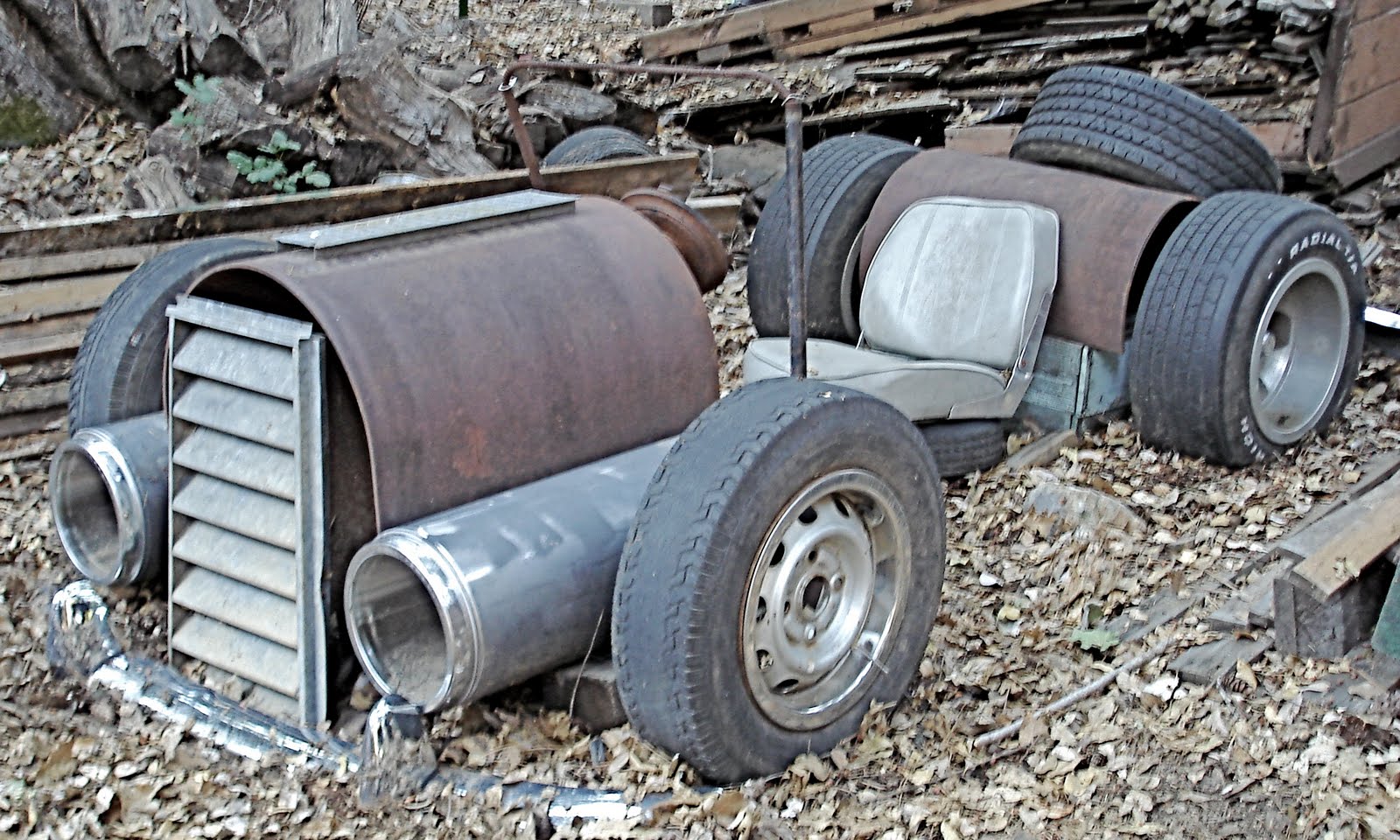
bricolage


Don't need no Chevy, no Ford, no Dodge.
Got my own hot Bricolage! —J.C.H.


——————————————————————
MEANING

bricolage /brē-ko-LAZH'/ n  ➤ In art or literature, a construction or creation from a diverse range of available things:  the chaotic bricolage of the novel is brought together in a unifying gesture.
 ➤ Something constructed or created in this way: bricolages of painted junk. —NOAD
•
bricolage: v ➤ To make creative and resourceful use of whatever materials are to hand. —Claude Levi-Strauss.  Mid 20th century: French, from bricoler 'do odd jobs, repair.'
•
bricoleur /brē-ko-LAIR'/ n ➤  A person who engages in bricolage.  Mid 20th century: French, literally 'handyman.' —NOAD

——————————————————————
Bricolage IN USE
➢ There’s a spirit of bricolage running through this [fashion] season, as if designers wanted their clothes to convey as many possibilities as possible. — Armand Limnander, "Group Hug | Paris," Women's Fashion, March 5, 2010.
➢ At the same time it's clear that technology and the mechanisms of the Web have been accelerating certain trends already percolating through our culture--including the blurring of news and entertainment, a growing polarization in national politics, a deconstructionist view of literature . . . , the prominence of postmodernism in the form of mashups and bricolage, and a growing cultural relativism . . . . —Michiko Kakutani. "Texts Without Context," The New York Times, "Arts & Leisure," March 21, 2010, 25.
➢ Here is a White Christian Nationalist group [the Tea Party] whose worldview is a bricolage of Ayn Rand novels, fundamentalist jeremiads and an ethnically-cleansed "history"  —"GOP, step away from the Tea Party," The Guardian - ‎Mar 22, 2010‎
——————————————————————
COMMENTS on bricolage and bricoleur

In his book The Savage Mind (1962), French anthropologist Claude Levi-Strauss [klod la'-vi stros] contrasted two types of problem solvers: the Bricoleur, who takes the "do-it-yourself" approach and the Engineer, who works "by-the-book."  Wikipedia explains these two concepts further:  
[bricoleur] has come to mean one who works with his hands, usually in devious or "crafty" ways in comparison to the true craftsman, whom Lévi-Strauss calls the Engineer. The bricoleur  is adept at many tasks and at putting preexisting things together in new ways. The Engineer deals with projects in their entirety, taking into account the availability of materials and tools required. The bricoleur approximates "the savage mind" and the Engineer approximates the scientific mind." 
Besides anthropology, bricolage functions usefully in many other disciplines.  Here are a few of them, gleaned from the Wapedia's page on bricolage:
In music, "Instrumental bricolage . . . includes the use of found objects as instruments, such as in the cases of  
• Irish Spoons,   
• humming through a comb and wax paper,
• Trinidadian Steel Drums (made from industrial storage drums),
• African drums and thumb pianos made from recycled pots and pans." 
Not to mention the tinkered sound of Punk.
In the visual arts, "bricolage is [viewed] as a technique where works are construted from various materials on hand, and is seen as a characteristic of postmodern works."  The collage art form is of its essence a bricolage.
In theatrical improvisation, bricolage makes use of  "the stage and the [pantomimed] materials [that] are all made  up on the spot to represent actual things the players know from past experience."
In philosophy the bricoleur has be likened to Coyote, the archetype of the trickster. 
The fashion industry uses the  bricolage style by "incorporating  items typically utilized for other purposes. For example, candy wrappers are woven together to produce a purse."
In television, MacGyver has been described as a "paragon of a bricoleur, creating solutions for the problem to be solved out of available found objects" and the A-Team was known for "creating, mainly weapons, out of any objects available."
Information systems, internet programming, as well as business organization and management, all employ bricolage. To read about its role in these applications, visit (wapedia.mobi/en/Bricolage).
§

Needless to say, this bricolage on bricolage has been a pleasure for this bricoleur to bricolage.  

#
666 words

March 25, 2010

grandee


A Spanish Grandee, 
Late Middle Ages
From The Pictorial Encyclopedia 
of Fashion (1968) Ed. Paul Hamlin
——————————————————————
MEANING

grandee n [gran-DEE] 
➤ A person of the highest eminence or high rank in Spain or Portugal
➤ A person of eminence or high rank

——————————————————————
IN USE
➣ "With humor, reasonableness, and a touch of sarcasm, [President Obama] invited the Republican grandees in the audience to play the role of straight man, so to speak, and they obliged: row upon row of pale, middle-aged white men, unmoving and unmoved, frowning or smirking at every Presidential request for cooperation.—Hendrik Hertzberg. "Sparrin' Words," The Talk of the Town, The New Yorker, Feb. 8, 2010.
➣ "His name was Bernie Madoff, a former chairman of NASDAQ and an industry grandee." — "Prophets of the financial crisis," Economist, March 18, 2010.
➣ "The Planet Mars..hath been reckoned one of the Grandees in Aetherial Regions." 1686 Goad, Celest. Bodies II. iv. 194 —OED
——————————————————————
ORIGIN

[Spanish and Portuguese grande, "great (one)." from Latin grandis, grand.] —AHD


——————————————————————
COMMENTS

For a Spanish Grandee of the late middle ages, a grandiose hat was the thing!

Now that's a "Grandee-ose" Hat!

A Grandee in early Spain, Brewer notes, "was a nobleman of the highest rank, who had the privilege of remaining covered in the king's presence." By "remaining covered" Brewer mean they could wear their grandiose hats in the presence of the king.  
The title appears first to have been assumed during the late Middle Ages by certain of the ricos hombres, or powerful magnates of the realm, who had by then acquired vast influence and considerable privileges, including one—that of wearing a hat in the king’s presence—which later became characteristic of the dignity of grandee. —The Encyclopaedia Britannica [EB]
Eventually, specific protocols about these proto-symbolic hats were set in place:  
[B]y the early 17th century the grandees of Spain had been divided into three classes: those who spoke to the king and received his reply with their heads covered; those who addressed him uncovered but put on their hats to hear his answer; and those who awaited the permission of the king before covering themselves.—EB

Grandees were allowed another privilege, to be "addressed by the king as 'my cousin” (mi primo), whereas ordinary nobles were only qualified as “my kinsman” (mi pariente).—EB


Jump to present time in the United States and we learn that Republican grandees of  the House of Representatives who met in February in Baltimore to discuss health care reform with President Barack Obama found themselves addressed by their leader not with the distant "my kinsman" formality of  "Congressman" but with the "my cousin" first-name familiarity of John, Eric, and Mike.  


Use of the informal direct address did not help warm these Republican grandees  into accepting the President's ideas.  Their "No we won't!" minds had been locked in cold storage long before the conference.

Charles Dharapak/Associated Press
G.O.P. Grandees, 2010
From left, John Boehner, House minority leader, Eric Cantor, House minority leader, and Representative Mike Pence listened to President Obama speak at a Republican retreat in Baltimore, February 2010.
#

513 words cold

March 9, 2010

sobriquet


Jeffrey Scales/HSP Archive
Jerry Brown a.k.a. 
"Governor Moonbeam"
c. 1975 


——————————————————————
MEANING


sobriquet [SO'-bri-KAY']  n.  
1. An affectionate or humorous nickname
2. An assumed name —AHD

——————————————————————
IN USE
➢ "For the uninitiated, ‘Governor Moonbeam’ became Mr. [Jerry] Brown’s intractable sobriquet, dating back to his days as governor between 1975 and 1983, when his state led the nation in pretty much everything — its economy, environmental awareness and, yes, class-A eccentrics." —Jesse McKinley, "'Governor Moonbeam' Recalled," The New York Times, "The Nation," March 7, 2010, 5.
➢ "Guess we are all aware that much adored celeb couple Brad Pitt and Angelina Jolie, known better by their grapevine sobriquet ‘Brangelina,’ have already disproved the recent song and dance in the buzz circles, over their rumored ‘split’." —entertainmentandshowbiz.com, Feb. 19, 2010. 
➢ "With Nixon embroiled in his Watergate defence, [Alexander] Haig took on an expanded role, handling many of the president's governing chores, and earning the sobriquet, 'the thirty-seventh-and-a-half president'," said Politico.com. —By Madeleine Morris, BBC News, WashingtonBBCnews.com, 20 February 2010. 
——————————————————————
ORIGIN
From the Old French soubriquet, chuck under the chin. —AHD
First cited: 1646. –OED

——————————————————————
COMMENTS
How does sobriquet differ from nickname?

The American Heritage Dictionary answers the question by usefully describing a conceptual hierarchy among the terms appellation  (the broadest term), sobriquet  (the narrowest), and nickname (an intermediate middle):
An appellation is a name, other than a proper one, that describes or characterizes, generally in pictorial terms, and that gains currency more through use than through a formal act of designation [as with a denomination or a title]: "Great Emancipator" is thus an appellation for Lincoln.
A nickname is an appellation with informal, sometimes humorous, overtones, such as "Honest Abe."
A sobriquet is an especially [emphasis added] humorous or picturesque nickname.
Since the AHD offers no example of sobriquet for Abraham Lincoln, I offer these  historical instances — "The Illinois Ape,"  "Ignoramus Abe," and "King Linkum the First" — each phrase, it appears, attempting to be especially humorous or picturesque within its specific pejorative intention.

——————————————————————
ADDENDUM
For Those Readers Curious About the Genesis of Jerry Brown's Sobriquet "Governor Moonbeam."

In "'Governor Moonbeam' Recalled" (cited above), Jesse McKinley relates the origin of Jerry Brown's sobriquet "Governer Moonbeam":
The nickname was coined by Mike Royko, the famed Chicago columnist, who in 1976 said that Mr. Brown appeared to be attracting “the moonbeam vote,” which in Chicago political parlance meant young, idealistic and nontraditional.
The term had a nice California feel, and Mr. Royko eventually began applying it when he wrote about the Golden State’s young, idealistic and nontraditional chief executive. He found endless amusement — and sometimes outright agita — in California’s oddities, calling the state “the world’s largest outdoor mental asylum.”
“If it babbles and its eyeballs are glazed,” he noted in April 1979, “it probably comes from California.”
[The article continues: "Governor Moonbeam."]

#